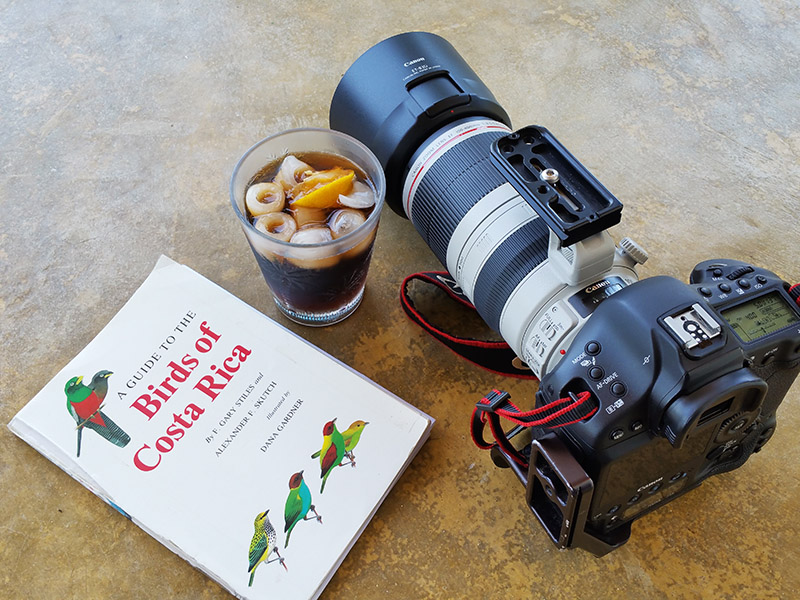

photo courtesy of Steve Patterson
Ethan photographs
with the Canon EOS system.
Special thanks to Canon Canada for their support through the Canon Pro Services
program.
Digital Bodies: EOS 1DS mark III
Lenses: EF 500mm f/4IS; EF 70-200 f/2.8 IS; EF 100mm //f2.8 macro; EF 17-40mm f/4
Canon Tele-Converters & Extension Tubes
Flashes: Canon EOS 580 EX II; 430EX; Better Beamer flash extender; Gary Fong diffusers and Lumiquest soft boxes
Support: Gitzo GT3540LS tripod; Manfrotto 055 tripod; Wimberley gimbal head; Kirk ball head; Kirk car window mount; BLUBB beanbag
Memory: SanDisk Extreme cards; Western Digital USB powered portable hard-drives
Singh-Ray Filters: Warming Polarizer LB (thin), Colorcombo (thin), Gold n Blue Polarizer, Vari-ND, various ND grads (both 4x6" size and standard P-sizes), LB polarizer custom for Canon long-lens drop in unit
Printer: Epson 2200
It's Not about the Gear!
For many years when I was getting started in nature photography, I was hungry for better gear. All I could think about was getting better lenses, the latest pro bodies and every accessory available. Somehow I had gotten the idea that having more gear would make me a better photographer - maybe even a pro. But top notch gear is awfully expensive and I couldn't afford it. So to 'get by' I bought used gear that was always a generation or two behind. With that old gear, and a heck of a lot of hard work and determination, I built a collection of 30,000 nature images and established my stock photography business. Many of my best images were made before I had a camera that could autofocus very well.
These days I'm fortunate to make enough money at photography to afford (and justify) some cutting-edge camera equipment. I recently shifted to a high-end digital body and I even bought a couple of brand new lenses. Building on the knowledge and technique I've developed from over a decade of intense shooting, I'm using the new gear to push my photographic envelope - capturing shots I never thought were possible before.
But here's the bottom line: gear is only one small part of the equation for success in nature photography. While most photographers are arguing over Canon vs Nikon or who's got more megapixels, it's the guy or gal out in the field who spends more time shooting, improving their technique and learning about nature who comes out ahead - always. My basic philosophy has been to invest my time and money on shooting - using my existing gear to its fullest potential. The choice between a new 'camera toy' or a trip to a great natural area is an easy one for me.
So Why Canon?
I switched to the Canon EOS system several years ago because it's the best fit for the kind of shooting I do. Canon is a huge company and they invest heavily in research and development - so it's no surprise that they're industry leaders for many technologies. Most noteworthy, they pioneered Image Stabilized (IS) lenses which are extremely valuable for nature photographers, who often shoot in low light, with long lenses that amplify shake. Canon's latest generation of digital bodies, like the EOS 1DSm2 and EOS 1Dm2 that I have been using recently, have extremely responsive autofocus. And Canon also has all the little accessories that a nature photographer commonly needs, such as autofocus extension tubes. Overall, I feel that the Canon EOS system offers the fewest limitations and the best potential for growth that parallels my needs as a nature photographer.
To those people out there shooting another brand, who are tempted to email me and tell me how great their system is compared to Canon (it happens all the time): don't bother, I believe you. I think any brand of gear in the hands of a good photographer can be used to make great photos. And besides, at the end of the day, all the debates about gear end at the photos.
Digital, eh?
A traditional guy like me, cautious about new stuff and very frugal when it comes to spending money on new gear - now gone digital? Pigs must be flying. I switched to digital capture in the fall of 2004 and although it was a hard decision, I have no regrets. In fact, I'm loving it. You can argue for days about the pros and cons, and feel free to. Here's my analysis that swayed me to digital.
Things I like
(love) about Digital:
1) Cheap to Shoot:
I shoot a ton of photos, you have to if you want to capture
action shots of birds and other wildlife. I was spending upwards of $10 grand a
year on film and processing, which is a load of money. Now I don't feel
apprehensive following a bird in flight at 8.5 frames per second. There's the issue
with storage and backup, but that's still cheaper than what I was spending
before.
2) Instant Feedback:
With digital, I have a pretty good idea right away if I got
the shot, especially confirming exposures with the histogram. It's way less
stressful than waiting weeks for slides to get back, only to find out I blew it.
Digital is also helping me push my creative limits - I'm experimenting more and
trying new shots because I can check to see if it's working out, and it doesn't cost me
any more to play around!
3) Exposure Latitude:
I can't make hard-fast scientific measurements to support
this, but to me it looks like digital has a wider exposure latitude than slide
film. It seems to be more like print film. Great for shadow detail.
4) Clean, Crisp Files:
Native digital files are crisper and cleaner than files
from scanned images. After all, it's a first generation file. I've made massive
enlargements from my 1DSm2 files - they blow away pretty much anything I've seen
from film.
5) No More Scanning:
Scanning slides is a tedious and boring job...
and thankfully I don't have to do nearly as much of it now. There's still a lot
of time at a computer when you shoot digital, but it beats scanning in my
opinion.
6) Speed of Production:
Photos are the product that I sell in my business, so
the quicker I have the products in my hand the better. In the past I've missed
sales because I was waiting for slides to return. Now when I get
a call from a client for a photo that I don't have, depending on what the
subject is, I can sometime go out and shoot it immediately and make the
sale.
The Challenges of
Digital:
1) Long-term Storage/Backup:
It takes diligence and time, and you need to be
redundant in case something happens to one set of files. I'm using a RAID system
on my computer (redundant drives), plus backup on external hard drives which I
store off-site in case my house burns down. Thankfully memory is getting cheaper
by the day.
2) Storage on Long, Remote Trips:
A week or two away from civilization means you
have to carry a laptop and spare batteries, or a small portable hard
drives that eats batteries. Either can be stolen while you're traveling.
Film was pretty easy to stash.
3) 1.x Factors in the Camera Body:
Most digital bodies, except the more expensive ones with full-frame sensors, have a 1.3-1.6x magnification factor inherent in the body [in
actuality, it's a cropping factor but that's a longer explanation]. This sucks
for wide-angle photography, which I love for landscapes. Most camera companies
have responded by developing affordable ultra-wide lenses. I now shoot primarily
with the full-framed sensor EOS 1DSm2, so this is no longer a problem for me.
More camera bodies with full-frame sensors are coming into market all the time,
and at reasonable prices.
4) Computer Time:
Digital requires a lot of time at a computer to transfer,
prepare and store the photos. It's an unavoidable reality which makes me
appreciate my time in the field even more.
5) Sensor Dust:
It's annoying and you'll certainly get it if you change lenses a
lot, which I do. But it can be beat with cautious technique, keeping your gear
(especially lens contacts) clean. It's also easy to clean the sensor thanks to
some new products on the market.
6) High Cost of Camera Bodies:
Digital bodies cost much more than comparable
film bodies, although prices are coming down all the time. For me, the high
initial cost is offset by the savings in film and processing.
This
site © Ethan Meleg, all rights reserved. No form of reproduction,
including copying or saving of digital image
files or text,
or the alteration or manipulation of said image files or text is
permitted. Any unauthorized use of these
images or text will be
prosecuted
to the full extent of federal copyright laws.